Six weeks ago, a niche B2B SaaS in the logistics-payroll space was nearly invisible in Google. Today, that same product has logged 398 clicks and 30,300 impressions from organic search over the last three months — most of it concentrated in the 30 days after we started shipping fixes. Average position: 7. Average CTR: 1.3%. This is the story of what we changed and what moved.
Niche SaaS SEO is a different game than e-commerce or content publishing. The total addressable search universe is small — maybe a few hundred high-intent queries that matter — but every single one is qualified. When someone Googles "fleet payroll software for FedEx ISPs", they aren't browsing. They're shopping. Getting found for those queries doesn't require traffic at scale. It requires showing up for the specific terms your buyers actually type.
The starting point: a niche SaaS with no search footprint
Our client (a logistics-payroll SaaS we'll keep anonymous here) had been live for several years with a strong product and a small but loyal customer base — all acquired through referrals and direct outreach. Their organic search numbers told the rest of the story:
- Average daily impressions in February and March 2026: under 20
- Average daily clicks: under 1
- Pages indexed in Google Search Console: a fraction of the actual site
- Lighthouse Performance score (mobile, homepage): in the low-to-mid range
- Core Web Vitals: failing on multiple URL groups
- Structured data: none
The product was good. The technical foundation underneath the marketing pages was not.
The audit: what we found
We ran the audit in two phases — automated tooling first (Lighthouse, PageSpeed Insights, Screaming Frog, GSC Coverage report), then manual review of the highest-value pages. The issues sorted into four buckets.
Indexing & crawl
- The XML sitemap was outdated and missing several product and feature pages
- Several important pages had
noindexdirectives left over from a staging environment - Internal links pointed to redirected or 404 URLs — wasting crawl budget
- The canonical strategy was inconsistent: some pages had self-referencing canonicals, others pointed to the wrong URL, others had none
On-page
- Meta titles were either generic ("Home", "Features") or stuffed with internal product jargon — none aligned with how buyers actually search
- Meta descriptions were either missing or auto-generated by the platform — no compelling pitch for SERPs
- H1 tags were inconsistent: multiple H1s on some pages, missing entirely on others
- Heading hierarchy skipped levels (H2 → H4) on key landing pages
- Most images had no alt text — invisible to search and to screen readers
Schema markup
- Zero structured data on the site — not even
Organizationmarkup on the homepage - FAQ blocks had no
FAQPageschema, leaving rich-result opportunities on the table - The product itself had no
SoftwareApplicationschema — Google had no machine-readable signal that this was a SaaS
Speed & Core Web Vitals
- Hero images shipped as full-size PNGs — some over 1 MB each
- Render-blocking CSS and JS in the critical path
- LCP (Largest Contentful Paint) was over 3 seconds on mobile
- CLS (Cumulative Layout Shift) failed on multiple URL groups due to dynamically-injected elements without reserved space
- No image lazy-loading, no priority hints for above-the-fold content
- Fonts loaded without
font-display: swap— invisible text during load
What we changed (the specific list)
SEO posts that say "we improved technical SEO" aren't case studies — they're sales pitches. Here's what we actually shipped in the 30 days starting April 2, 2026:
- Rewrote meta titles across every product, pricing, and feature page — each one aligned to a real buyer search term, not internal jargon
- Rewrote meta descriptions across the entire public site, optimized for CTR from SERPs (specific value, action verb, no truncation at 160 chars)
- Fixed H1 and heading hierarchy on every key landing page
- Added descriptive alt text to every above-the-fold and content-relevant image
- Built a proper XML sitemap and submitted it to GSC. Resubmitted twice during the engagement as new pages were optimized.
- Removed accidental
noindexdirectives left over from the staging environment - Audited and fixed internal links pointing to redirected or 404 URLs
- Implemented self-referencing canonical tags across all public pages
- Added
OrganizationandWebSiteJSON-LD schema to the homepage - Added
SoftwareApplicationschema to the product and feature pages so Google could understand this is a B2B SaaS - Added
FAQPageschema to every page with an FAQ block (rich-result eligible) - Added
BreadcrumbListschema across category and detail pages - Converted hero and content PNGs to WebP — single-page weight reductions in the 500 KB to 1 MB range on each page
- Set
loading="lazy"on every non-critical image,fetchpriority="high"on the LCP element - Preloaded the heading font and added
font-display: swapto eliminate FOIT - Inlined critical CSS for the above-the-fold viewport, deferred the rest
- Moved render-blocking third-party scripts to
deferor post-LCP load - Fixed CLS by reserving aspect-ratio space for every dynamically-loaded element
- Cleaned up duplicate meta descriptions and titles across the site
- Set up GSC email alerts for any future Core Web Vitals regression
None of these are exotic. Technical SEO at this stage is mostly about doing twenty ordinary things competently, then waiting for Google's crawl cycle to catch up.
The numbers, 30 days in
Here's what the graph looked like by mid-May:
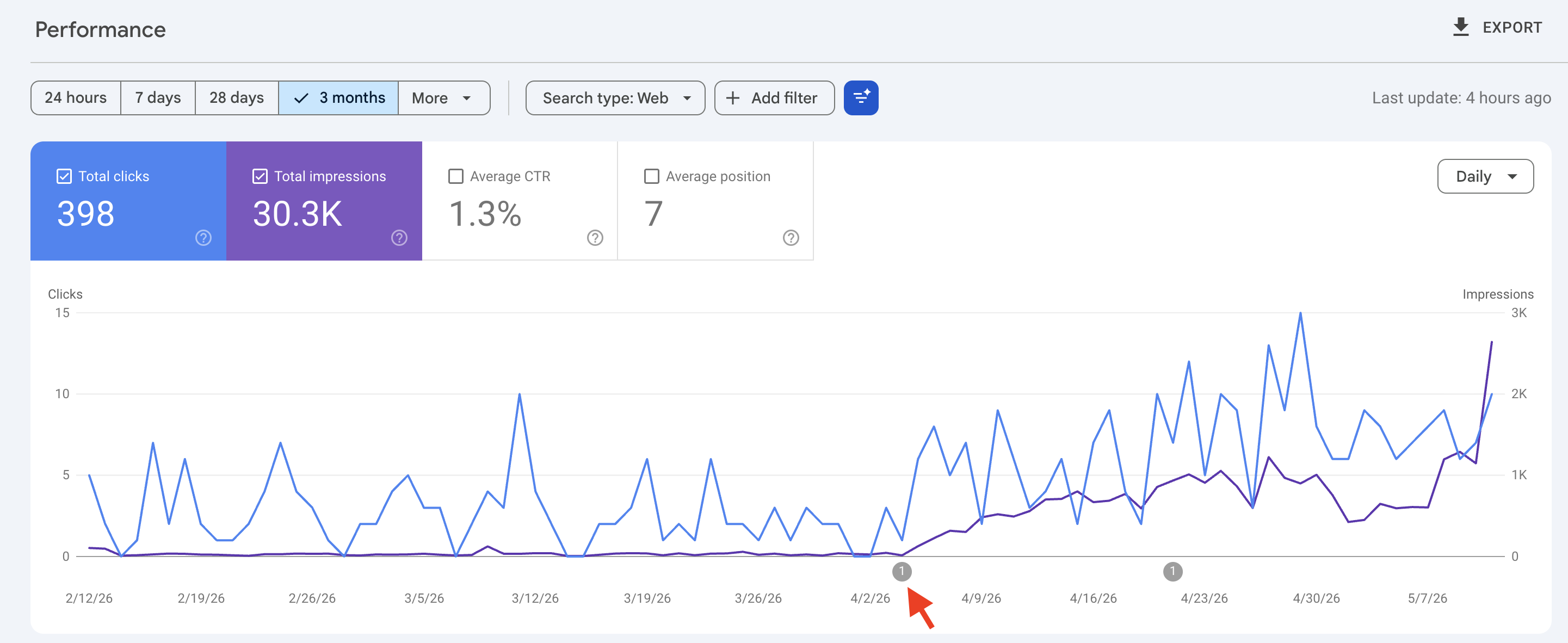
What the graph shows:
- Total clicks: 398 over the 3-month window — the overwhelming majority concentrated in the 30 days post-audit
- Total impressions: 30,300 — daily impressions climbing from under 100 to over 2,000 within the engagement
- Average CTR: 1.3% — meaningful for a B2B SaaS where individual clicks have high commercial value
- Average position: 7 — first page across the basket of queries the site appears for
- Peak daily impressions: over 3,000 by the end of the engagement, up from under 50 per day pre-audit
The shape of the graph matters as much as the totals. Both clicks and impressions show a clean inflection point at the audit start — not a slow drift, but a step change. That's the pattern of compounding technical SEO: each indexable, well-targeted page Google discovers becomes another opportunity to rank for adjacent queries.
What we learned about niche-SaaS SEO
Three things stood out from this engagement that are worth flagging if you're working in the same space.
1. The fix is rarely "more content" — it's making existing content findable. Most niche SaaS already has product pages, feature pages, and a blog. The problem isn't volume — it's that those pages are invisible to Google. Fix indexing, schema, and meta first. Add content later if you still need to.
2. CTR matters more in niche SaaS than ranking position. A 1.3% CTR on a B2B SaaS is healthy because every click is a qualified buyer. Spend time on meta titles and descriptions that earn clicks — not just on chasing position 1. A rewritten title that doubles CTR is worth more than a one-position rank gain.
3. Technical SEO compounds faster on small sites than large ones. Big sites have a long tail of low-priority pages diluting their crawl budget. Small SaaS sites have 30 to 100 pages — every one can be perfect. Shipping 20 specific fixes across a 50-page site has visible impact in weeks, not quarters.
Frequently Asked Questions
How long does SEO take to show results for a new SaaS?
For niche B2B SaaS with technical issues, the first signs of movement show up within 2 to 4 weeks of shipping fixes — Google's crawl and index cycle is faster than people remember. Meaningful organic traffic typically takes 60 to 90 days. The 30-day inflection point in this case study is on the faster end and depends on a small surface area, a clean technical baseline post-audit, and Google being able to crawl and index without obstacles.
Does schema markup actually move rankings?
Schema doesn't directly improve ranking — Google has been explicit about that. What schema does is make pages eligible for rich results (FAQ accordions, breadcrumb trails, software application snippets, etc.) and give Google a clearer machine-readable understanding of what each page is about. For a B2B SaaS, SoftwareApplication, Organization, FAQPage, and BreadcrumbList are the four schemas that matter most.
What's the biggest SEO mistake niche SaaS makes?
Writing pages for the founder's vocabulary instead of the buyer's. Internal product names, jargon, and feature-naming conventions almost never match what buyers type into Google. Every page on a SaaS site should be titled around a real search term — not an internal product taxonomy.
Is technical SEO worth it if you already have good content?
Yes — and arguably more than the other way around. Good content that Google can't crawl, can't index, or renders too slowly to be ranked has no SEO value. Technical SEO is the foundation; content is what fills the rooms. The engagement above didn't add a single new content page — every gain came from making the existing site findable.
Can the same approach work for a much larger SaaS?
The principles transfer, but the timeline does not. Larger SaaS sites typically have more legacy URLs, more cross-team coordination, and more dependent systems. A technical SEO engagement at that scale usually takes 90 to 120 days for the first inflection point, with continued compounding over the following quarters.
Want a similar audit?
If your SaaS site is technically clean but invisible in search — or vice versa — we run engagements like this regularly. Read about our SEO and digital marketing service, or get in touch to scope an audit of your own.